
If you're restoring a CJ, the most useful book on your bench might be one you never meant to read cover to cover: the factory parts catalog. Pioneer Motorworks has put the 1981 to 1986 Jeep parts catalog online on our Jeep parts catalog page. It covers every Jeep make and model from those years, CJs included.
Below is a little background on where catalogs like this came from, and a few ways to put this one to work today.
A dealer's book from the AMC years
The catalog dates from the AMC era. American Motors acquired Kaiser Jeep Corporation in early 1970 and owned the brand until Chrysler bought AMC on August 5, 1987 (Jeep 1970s history, Jeep 1980s history). Through the 1970s, AMC moved Jeep onto its own engines. Starting in 1973, every CJ came with an AMC-built 304 or 360 V8.
The early 1980s were a crowded time for the lineup. In the 1981 to 1986 window, Jeep dealers sold:
CJ-5 (Jeep's history page says it was discontinued after 1983), CJ-7 and the CJ-8 Scrambler
Full-size Wagoneer and Grand Wagoneer (SJ) and the J-10 and J-20 pickups
The compact Cherokee and Wagoneer (XJ) from 1984, and the Comanche (MJ) pickup in 1986
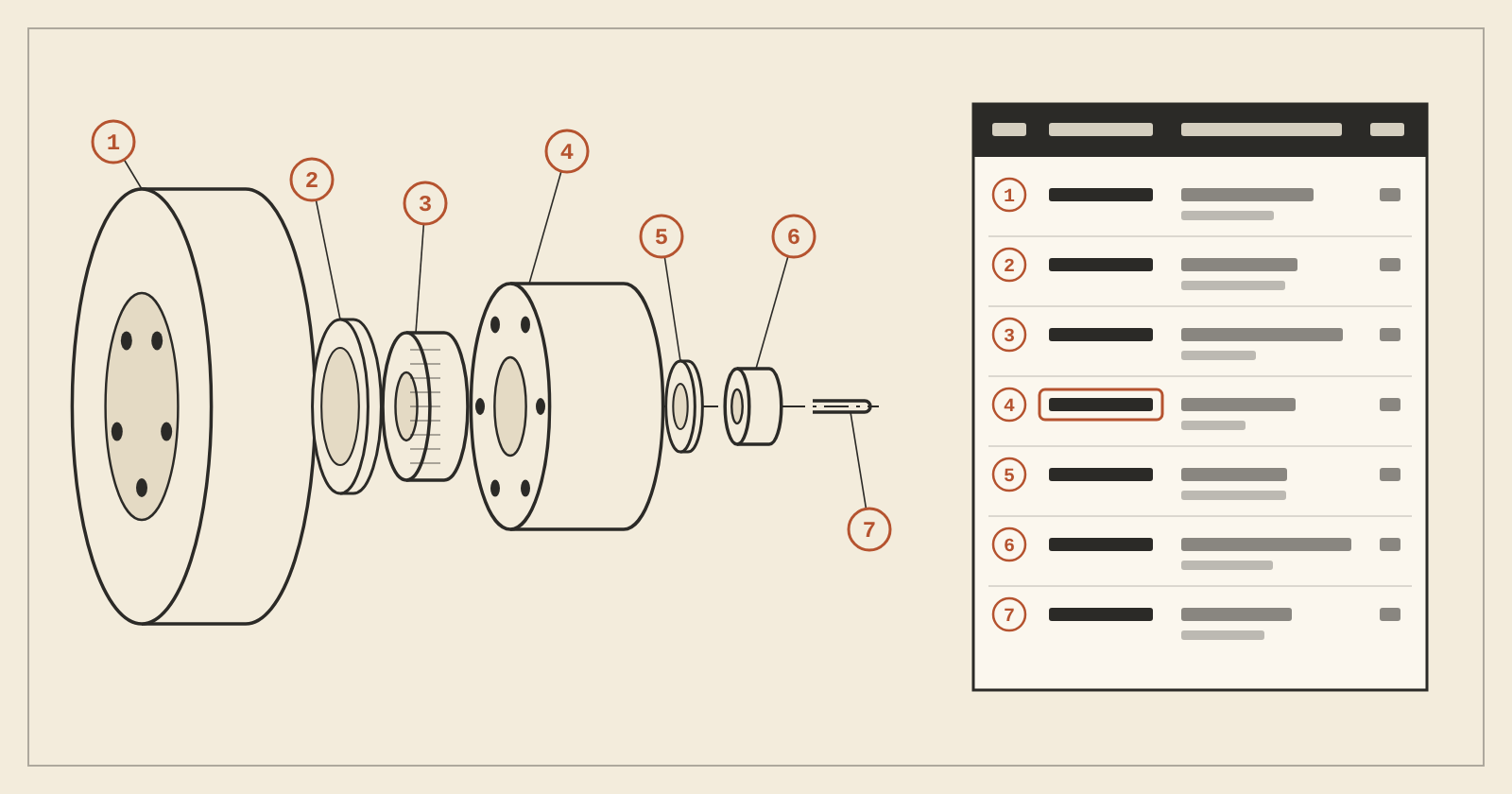
The parts catalog was how a dealer's parts counter kept all of this straight. It wasn't written for owners. A counterperson would use it to find the right factory part number for whatever was on the lift and then order it. Printed versions of the 1981 to 1986 book ran to two volumes and more than 1,000 pages (AutoPaper listing). Each entry gives a part number, description, quantity and application, plus an illustration. Sections run from front suspension and axles through the engine, fuel and electrical systems to body sheet metal and interior trim.
The CJ ended after 1986, and the Wrangler (YJ) took its place for 1987. Original copies of the catalog now turn up mostly through literature dealers and at swap meets, and many are worn from years on a parts counter.
What's on our catalog page
On the Jeep parts catalog page, click View Parts Catalog to open the full catalog in your browser. There's nothing to buy and no binder to hunt down.
Page 4 of the catalog explains the firewall tag and VIN codes. These tell you exactly which model, engine and build you have, and the rest of the catalog depends on knowing that. To decode your own Jeep, use our VIN decoder and firewall tag decoder. Every 1981 to 1986 Jeep has a 17-character VIN. Position 4 is the engine code (for example, C for the 4.2L inline six or B for the 2.5L four), positions 6 and 7 are the line and body (87 for a CJ-7, 88 for a Scrambler) and position 10 is the model year (B for 1981 through G for 1986).
The catalog belongs to our CJ Knowledge Hub. The hub also includes technical service manuals, vehicle dimensions, paint options and torque specifications.
Using it today: will this part fit?
The catalog is most useful for answering one question: does a part from another Jeep, or another year, fit mine? Factory part numbers settle it. When the same number shows up in the entries for two vehicles, it's the same part. The application column tells you which models and years each number covers.
To check whether a part interchanges:
Decode your VIN and firewall tag. Write down the model, model year and engine code before you open the catalog.
Find the right section. The catalog is organized by system (brakes, steering, cooling, fuel, electrical, body and so on), so start with the system the part belongs to.
Match the illustration. Use the exploded drawing to identify the exact piece, then note its reference number.
Read the part number and the application. Check which models, years and engines that number lists.
Look up the donor vehicle. Repeat the lookup for the Jeep the part is coming from. Same part number means a direct swap. A different number means the parts differ somehow, even if they look alike.
Some common ways to use this:
Buying from a parts Jeep. Before you pull a part from a Wagoneer or J-truck for your CJ, check that both share the part number, so you don't haul home something that won't bolt on.
Checking a year change. Factory parts sometimes changed partway through the 1981 to 1986 run. If the number changes from one model year to the next, buy for your exact year.
Checking engine-specific parts. Cooling, fuel, exhaust and electrical parts often depend on the engine. Match against your VIN's engine code, not just the model.
Searching for new old stock or reproductions. With the original factory number in hand, you can search listings and vendor catalogs by number instead of by description.
Keeping a restoration correct. If you're restoring to factory spec, the catalog shows what the factory actually installed on your model and year.
A few tips
Factory part numbers were sometimes superseded later. If a number turns up nothing, search for its replacement.
Expect previous owners to have swapped parts. The catalog tells you what the factory installed, not what's on your Jeep today, so check before you order.
Keep a notes file for your build with your VIN decode, paint code and the part numbers you've confirmed. You'll use it again.
Open the Jeep parts catalog, decode your VIN, and start with the next part on your list. If you have questions about your CJ, email us at howdy@pioneermotorworks.com.